

In the world of innovation, two heads are often better than one. However, when those two heads create a patentable invention or a copyrighted work together, they enter a “legal marriage” known as Joint Ownership.
While sharing the glory is easy, sharing the licensing rights is where things get complicated. If intellectual property (IP) is co-owned by multiple parties, understanding how joint ownership impacts the ability to monetize that IP is critical.
The Default Trap and Why It Catches Co-Owners Off-Guard
Many co-owners operate under the assumption that joint IP ownership works like a standard piece of commercial real estate: everything is split 50:50, and both parties must sign off on any major decisions.
In IP law, when a contract is silent, the law steps-in with its own “default settings” and these settings vary depending on geography and the type of IP. For example:
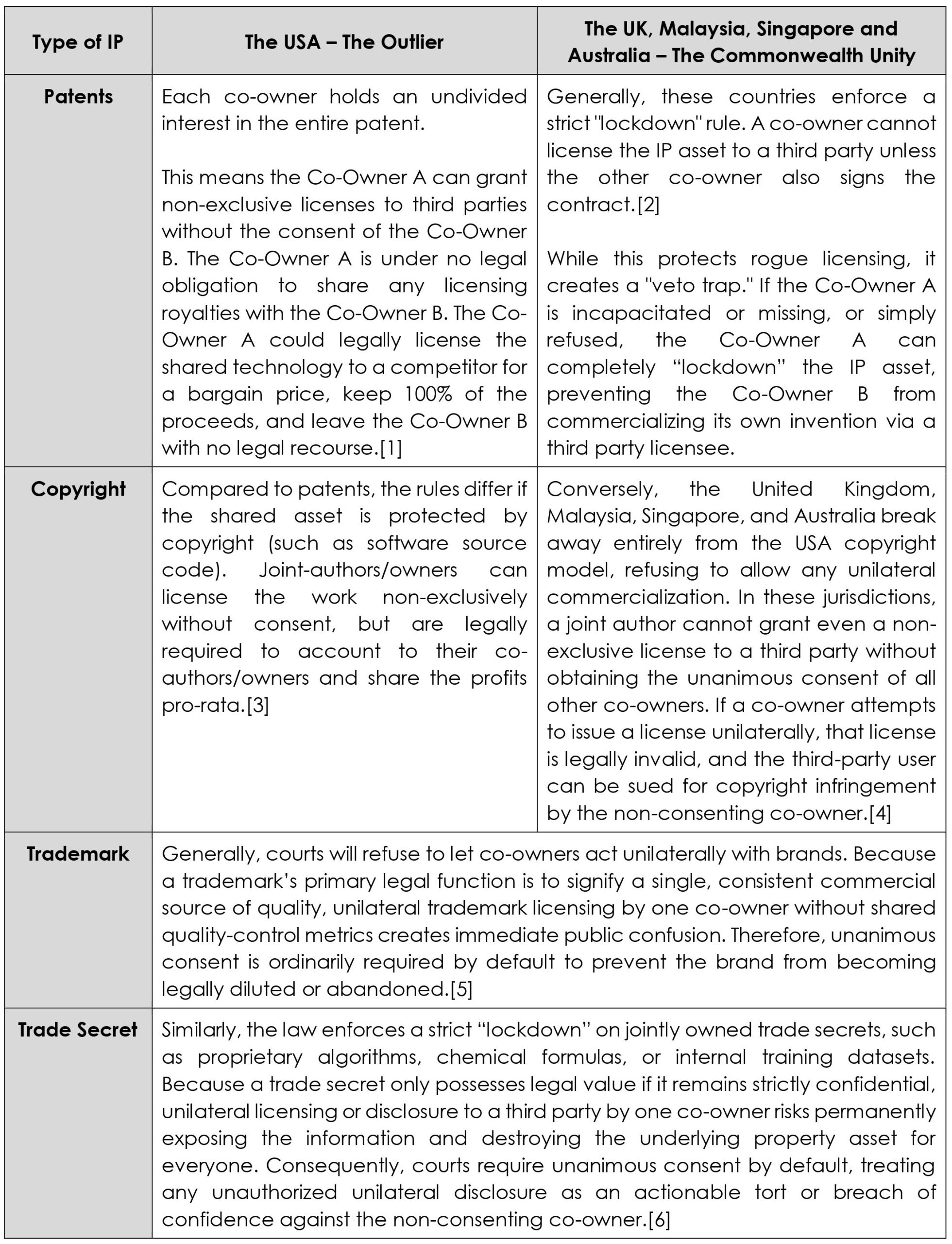
The Litigation Reality
Relying on default statutory laws means the business strategy is dictated by whichever country’s court ends up hosting your lawsuit. It turns a valuable corporate asset into a jurisdictional gamble.
How Joint Ownership Destroys Licensing Leverage
When an IP owner wishes to license the IP in a licensing agreement, joint ownership introduces three major hurdles:
1. The Veto on Exclusivity
If a licensee requires an exclusive license, all co-owners must sign the agreement. A minority co-owner holding a fraction of the intellectual contribution possesses 100% veto power. A deal can be held hostage for a disproportionate payout demand by a co-owner.
2. The Enforcement Nightmare
To maintain the value of a license, one must be able to enforce the IP rights against infringers. In some jurisdictions, procedural rules governing jointly owned patents may require the participation or joinder of other co-owners before infringement proceedings can proceed effectively.7 A reluctant, missing, or uncooperative co-owner can therefore create significant enforcement challenges, potentially delaying or complicating efforts to stop infringers from devaluing the licensee’s market exclusivity.
3. License Dilution
Without a restrictive agreement, a co-owner could grant non-exclusive licenses to anyone. This severely dilutes the market value of the IP. No sophisticated licensee will pay premium rates for a technology license where the exact same technology can be licensed to the licensee’s competitors.
The Corporate Solution: Setting Up the Legal Sandbox
When two or more persons co-create valuable IP, leaving the IP asset under “joint-names” is a recipe for litigation. Depending on the budget, timeline, and commercial goals, there are several distinct paths to neutralize the treacherous statutory default laws.
1. Solution 1 (The Gold Standard): A Holding Company (SPV)
Instead of jointly owning the IP as separate individuals, the co-owners can form a completely new corporate entity – a Special Purpose Vehicle (SPV) – and assign 100% of the IP ownership to this new company. The co-owners then become shareholders in this holding company, and their relationship is governed by a Shareholders’ Agreement (SHA).
The Pros:
- The Single-Owner Advantage: To the outside world, the licensees and the courts, the IP has one single owner – the new company. This completely eliminates jurisdictional default traps regarding joint licensing or enforcement.
- Corporate Governance: Decision-making relies on structured corporate law (e.g., board seats, majority votes, or veto thresholds defined in the SHA), rather than messy interpersonal contract negotiations.
- Clean Liquidity: If one co-owner wants out, that person simply sell their shares in the company. The underlying IP remains safely locked inside the company, completely uninterrupted.
- Financial Consolidation: All licensing fees and royalties flow directly into the company’s bank account, making tax handling, expense deductions, and dividend distributions transparent.
The Cons:
- Administrative Overhead: Setting up a new corporation requires legal incorporation fees, separate tax filings, yearly accounting audits, and ongoing corporate secretarial maintenance.
- The “Locked-Asset” Risk: If the company enters into a dissolution or bankruptcy, distributing its assets, including IP, can be a lengthy, court-supervised nightmare.
2. Solution 2 (The Tactical Fallback): The Joint Development Agreement (JDA)
If the co-owners do not have the budget, time, or commercial appetite to birth a new corporation, they must resort to a Joint Development Agreement (JDA). The IP remains in the co-owners’ names, but this extensive contract acts as a “prenuptial agreement” that explicitly strips away and overrides the default laws of the country.
The Pros:
- Speed and Low Cost: There is no company to register, no board to form, no SHA to execute and no company administrative overhead.
- Flexibility: The clauses – operational clauses, milestone deadlines, and individual responsibilities, etc. – can be customised without being bound by rigid corporate statutory rules.
The Cons:
- The Privity Problem: Third parties (like licensees or patent infringers) are not parties to your JDA. To sue an infringer, the reluctant co-owner still has to be dragged into court as a co-plaintiff because the contract does not change the underlying title on the patent registry.
- The Dilution and Rogue Risk: If the Co-Owner A breaches the JDA and grants an unauthorized license behind the Co-Owner B’s back, the remedy is still limited to suing the Co-Owner A for breach of contract. The licensee of the breaching Co-Owner A may still have the right to use the technology in the meantime because the breaching Co-Owner A has the legal title to grant it.
3. Solution 3 (The Clear Divider): The Cross-Licensing Framework
To untangle the operational futures from day one, joint ownership should be skipped entirely. Instead, the Co-Owner A takes 100% sole legal ownership of the core IP asset, and immediately grants an exclusive, perpetual, royalty-free, worldwide license to the Co-Owner B for a specific “Field of Use” or geographical territory (and vice versa for any sub-components).
The Pros:
- Absolute Autonomy: Neither party can hold the other hostage. The Co-Owner A can license the technology in sector A, while the Co-Owner B can commercialize in sector B. Each commands their own sandbox without asking for permission.
- Clean Enforcement (in favour of the Co-Owner A only): Because the Co-Owner A is the 100% legal owner, the Co-Owner A can sue infringers instantly without needing the Co-Owner B to sign onto the lawsuit.
The Cons:
- The Valuation War: Deciding who gets to be the “Sole-Owner” and who has to settle for being the “Exclusive Licensee” creates massive friction during negotiations.
- The Field-Overlap Risk: If the line between the Co-Owner A’s field and the Co-Owner B’s field becomes blurry, the co-owners may inevitably end up suing each other over scope encroachment.
- The Co-Owner B’s Enforcement Dependency Trap: Because the Co-Owner A retains 100% legal title, the Co-Owner B cannot legally sue infringers in its own sector alone. Courts require the legal title holder to be part of the lawsuit. The Co-Owner B is dependent on the Co-Owner A’s cooperation to file a lawsuit.
4. Solution 4 (The Fiduciary Ownership Model): A Trust
Under this equity-based structure, the IP is registered under the Co-Owner A’s name only (acting as the sole legal Trustee). However, both co-owners execute a formal Trust Deed declaring that the Co-Owner A holds the asset for the beneficial, economic interest of both co-owners. The Co-Owner A handles all administrative filings and licensing logistics smoothly as a single owner, but is legally mandated to pass a pro-rata share of all financial fruits back to the Co-Owner B.
The Pros:
- Seamless Dealmaking: Potential licensees only have to negotiate with one person, i.e.. the Co-Owner A, and there is no dual-signature gridlock.
- Low Administrative Friction: It provides the single-owner efficiency of an SPV (Solution 1) without the heavy cost of incorporating and maintaining a brand-new company.
The Cons:
- The Imbalance of Power: The Co-Owner B is entirely dependent on the Co-Owner A’s competence and honesty. If the Co-Owner A makes a bad business decision, mismanages a litigation budget, or fails to pay patent maintenance fees, the Co-Owner B’s economic asset is dragged down with them.
- Audit Dependent: The Co-Owner B must constantly monitor and audit the Trustee to ensure that licensing royalties are being calculated honestly and distributed fairly.
Conclusion: The Strategic Matrix – Balancing the Corporate Framework
Ultimately, the commercial value of an innovation should dictate the legal architecture. When navigating joint ownership, the following definitive playbook can be used to select the optimal structural model:
- Form a SPV (Solution 1): If the jointly owned IP is a “crown jewel”, bite the bullet and absorb the initial incorporation overhead to unify ownership under a single corporate vehicle to centralize commercial control and eliminate deadlock in future licensing.
- Deploy a Standalone JDA (Solution 2): Save contractual joint development agreements for short-term, lower-stakes R&D collaborations where commercial exposure is minimized.
- Utilize Cross-Licensing (Solution 3): Deploy this framework only if the respective target commercial markets are entirely distinct and that businesses will never cross paths.
- Establish a Trust (Solution 4): If the co-owners are asset-rich but cash-poor, use a unitary title trust framework to preserve dealmaking efficiency and protect transactional speed.
- U.S. Patent Law: Under 35 U.S.C. § 262, in the absence of any agreement to the contrary, joint owners of a patent may make, use, offer to sell, or sell the patented invention without the consent of and without accounting to the other owners.
- The UK, Malaysia, Singapore and Australia Patent Law:
- United Kingdom: Under Section 36 of the UK Patents Act 1977, while a co-owner may exploit the invention for their own benefit without consent, they cannot grant a license, assign, or mortgage their share without the unanimous consent of the other co-owners.
- Malaysia Patent Law: Governed by Section 40 of the Malaysian Patents Act 1983, specifying that joint patent owners must act jointly to conclude licensing or assignment agreements with third parties.
- Singapore Patent Law: Under Section 46 of the Singapore Patents Act 1994, joint proprietors are entitled to exploit the patent individually, but are explicitly barred from granting a license or assigning their interest without the consent of all other co-owners.
- Australia Patent Law: Under the Australian Patents Act 1990 (Cth), a co-owner may exploit the patent for their own benefit but cannot grant a licence or assign an interest without the consent of the other co-owners.
- U.S. Copyright Law: See 17 U.S.C. § 201(a); joint authors are co-owners of copyright in the work. Under default U.S. principles, a joint owner may grant non-exclusive licenses unilaterally subject to a legal duty to account for and split profits pro-rata.
- The UK, Malaysia, Singapore and Australia Copyright Law:
- United Kingdom Copyright Law: Section 10 of the Copyright, Designs and Patents Act 1988 defines a work of joint authorship. Copyright in such works is owned jointly by the co-authors, and, absent agreement to the contrary, licences and assignments of copyright must be granted collectively by all co-owners.
- Malaysia Copyright Law: Sections 3 and 13 of the Copyright Act 1987 recognise works of joint authorship and confer copyright ownership jointly upon the authors. As copyright constitutes a single proprietary right held jointly, any assignment or licensing of the copyright must be undertaken collectively by all co-owners unless otherwise agreed.
- Singapore Copyright Law: Under Section 149 of the Singapore Copyright Act 2021, references to the owner of copyright in a work of joint authorship are references to all joint authors collectively. Accordingly, any licence granted in respect of the copyright must be granted by all co-owners acting together.
- Australia Copyright Law: Sections 35 and 78 of the Copyright Act 1968 (Cth) recognise joint ownership of copyright and the requirement that dealings with the copyright be undertaken by all co-owners collectively unless otherwise agreed.
- Joint Trademark Ownership & Unilateral Licensing Restraints:
- United States: Under the Lanham Act (15 U.S.C. § 1051 et seq.) and common law, a trademark must identify a single source; licensing by a co-owner without shared quality-control metrics is deemed an invalid “naked license,” causing an involuntary abandonment of the trademark.
- United Kingdom: Governed by Section 23 of the UK Trade Marks Act 1994; under Section 23(4)(a), a co-proprietor is explicitly prohibited from granting a license to use the registered trademark without the express consent of all other co-proprietors.
- Malaysia: Governed by Section 63 of the Malaysian Trademarks Act 2019; under Section 63(4)(a), a co-proprietor is contractually barred from granting a trademark license to any third party without obtaining the prior consent of the other co-proprietors.
- Singapore: Under Section 37 of the Singapore Trade Marks Act 1998; specifically, Section 37(4)(a) dictates that a co-proprietor may not, without the consent of the other co-proprietors, grant a license to use the registered trade mark.
- Australia: Under Section 20 of the Australian Trade Marks Act 1995 (Cth); under Section 20(5), the registration rights of joint owners must be exercised as if they were the rights of a single person. Consequently, neither joint owner can unilaterally license the mark to a third party.
- Trade Secret Protection and Breach of Confidence Principles:
- United States: Governed by the Defend Trade Secrets Act, 18 U.S.C. §1836 et seq. Trade secret protection exists only where reasonable measures are taken to preserve secrecy. Unauthorized disclosure by a co-owner may destroy the protectable status of the information and expose the disclosing party to legal liability depending on the governing contractual and ownership arrangements.
- United Kingdom: Governed by the Trade Secrets (Enforcement, etc.) Regulations 2018 together with the equitable doctrine of breach of confidence. Unauthorized disclosure of jointly controlled confidential information may constitute a breach of confidence.
- Malaysia: Governed primarily by the common law doctrine of breach of confidence. Unauthorized disclosure of jointly controlled confidential information may give rise to a claim for breach of confidence.
- Singapore: Governed principally by the common law doctrine of breach of confidence. Unauthorized disclosure of jointly controlled confidential information may constitute an actionable breach of confidence.
- Australia: Governed by equitable and common law principles relating to breach of confidence. Unauthorized disclosure of jointly controlled confidential information may give rise to an action for breach of confidence.
- Patent Enforcement by Joint Owners and Licensees:
- United States: Patent enforcement rights are governed by federal patent law, including principles relating to standing and joinder in actions involving co-owners and exclusive licensees.
- United Kingdom: Sections 66 and 67 of the Patents Act 1977 contain provisions governing infringement proceedings involving co-proprietors and exclusive licensees.
- Malaysia: Sections 40 and 61 of the Patents Act 1983 govern enforcement rights of joint owners and licensees, including the right of a joint owner to institute infringement proceedings independently.
- Singapore: Sections 72 and 74 of the Patents Act govern infringement proceedings involving proprietors and exclusive licensees.
- Australia: Section 120 of the Patents Act 1990 (Cth) governs infringement proceedings by patentees and exclusive licensees.
Written by:
Airene Ho Eu Ghee
editorial@azmilaw.com
Corporate Communications
Azmi & Associates
16 June 2026

